

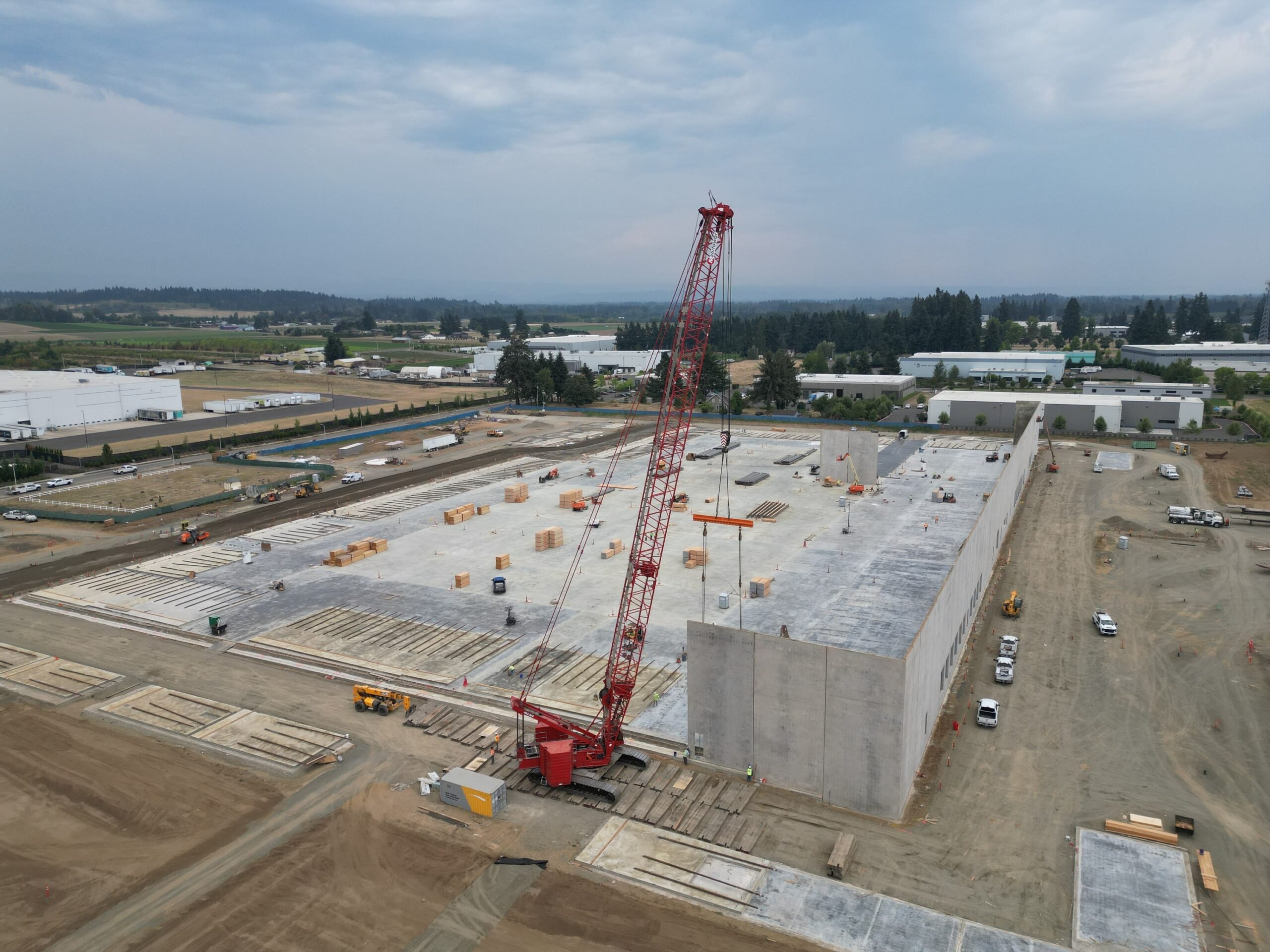


The Oregon Liquor and Cannabis Commission (OLCC) partnered with JE Dunn Construction, LRS Architects, and Cumming Group to deliver a new 347,645 square foot Distilled Spirits Distribution Center in Canby, Oregon. The purpose-built facility modernizes the state’s liquor supply chain, doubling distribution capacity and integrating advanced material-handling automation to strengthen reliability and statewide service.
Utilizing a Construction Manager (CM) model with a Guaranteed Maximum Price (GMP) contract, this approach supported collaboration from preconstruction through commissioning, allowing scope, budget, and constructability to be aligned early with OLCC’s operational goals. The resulting distribution hub improves speed, accuracy, and safety across OLCC operations while contributing long-term economic value to the Canby community.
The project presented a significant early financial challenge. Although state funding was granted in 2021, multi-year delays, inflation, and rising property costs strained the budget before work even began. When JE Dunn was contracted in 2024, the initial baseline estimate at Schematic Design exceeded the client’s budget by approximately $6 million dollars, with no opportunity for additional state funding.
To keep the project viable, JE Dunn rapidly conducted a Target Value Delivery (TVD) exercise, identifying 34 cost-saving opportunities totaling roughly $7 million dollars. The owner accepted enough of these items to realign the project with the available budget. From that point forward, TVD principles guided every major design and cost decision.
From the outset, the team focused on defining the required throughput, logistics strategy, and long-term operational goals, then shaped the building’s size, systems, and structural approach to meet those targets within the established budget. This early clarity around OLCC’s need to double statewide shipping capacity and integrate automated material handling became the foundation of continuous estimating throughout preconstruction.
JE Dunn provided detailed cost studies on key elements such as roof structure options, parapets, office locations, guard shack configuration, generator sizing, and the storm drainage system. These studies equipped the design team to progress with confidence while keeping the project on budget.
Early integration of the automation vendor was particularly critical. Conveyor pits, mezzanine supports, and equipment anchor points were coordinated in parallel with the structural design to avoid rework and ensure the facility would function as intended from day one. This collaborative TVD environment streamlined sequencing, optimized long-lead coordination, and protected the project’s delivery timeline despite weather and labor challenges.
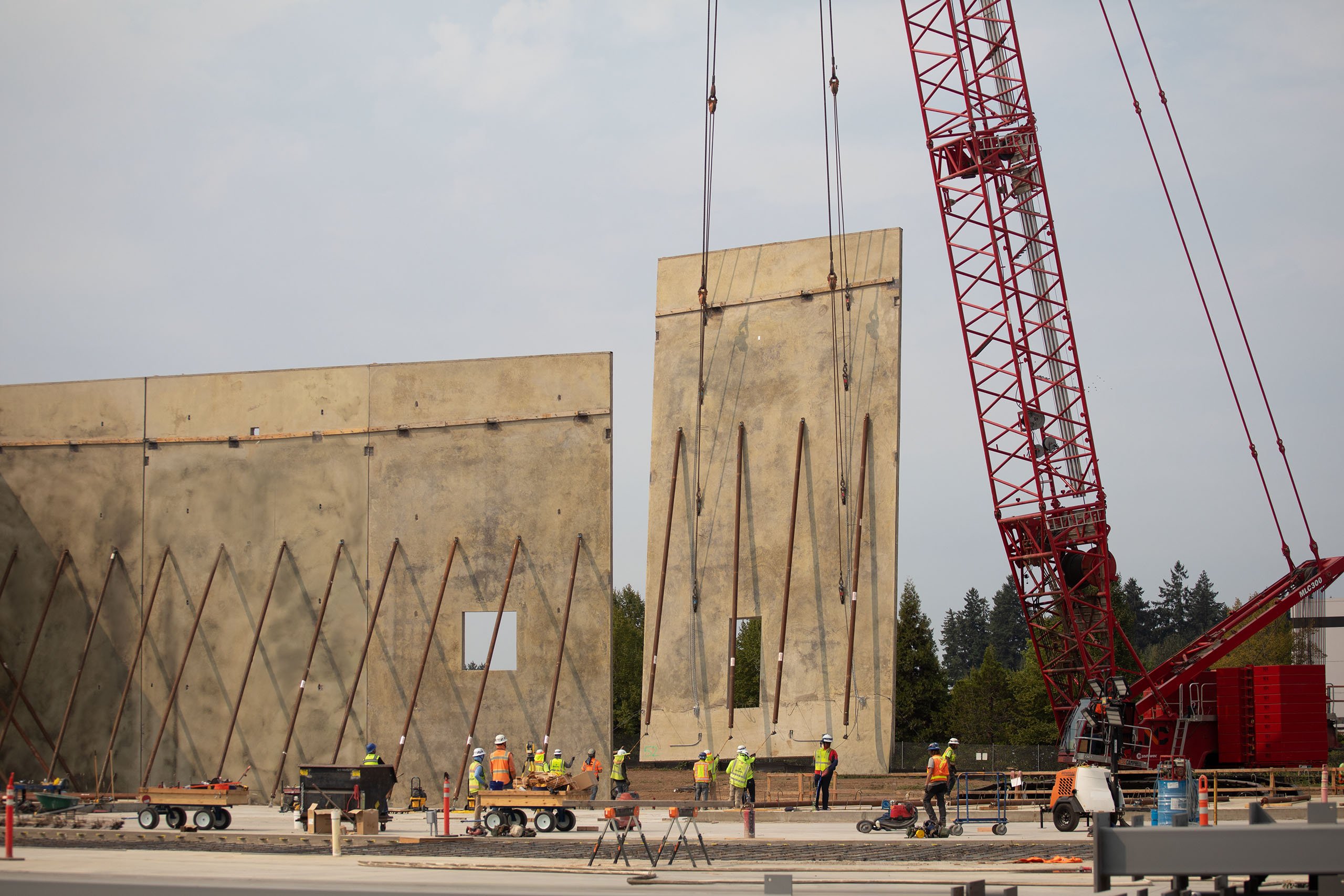
JE Dunn’s self-perform capabilities played a central role in delivering the project on schedule and to the highest quality standards. The team self-performed all major structural concrete work, including the on-site casting and erection of 98 tilt-up concrete wall panels, each weighing approximately 170,000 pounds.
This work represented one of the project’s most critical path activities and required precise coordination, specialized expertise, and rigorous quality control. JE Dunn’s Virtual Design and Construction (VDC) team developed a comprehensive “panel book,” detailing shop drawings, embeds, lifting requirements, and layout for every panel.
A crew of 25 JE Dunn carpenters and craft professionals managed the process from layout to lift, using laser-guided equipment to achieve installation tolerances within one sixteenth of an inch. In total, more than 14,000 cubic yards of concrete were placed across foundations, slabs, and wall panels, allowing multiple casts and lifts per day during peak phases despite challenging weather and labor conditions.
The new facility now supports simultaneous loading of up to 14 trucks, more than doubling the throughput possible at OLCC’s former Milwaukie warehouse.
By combining early cost certainty, continuous collaboration, and precise self-perform execution, the team delivered a highly efficient, future-ready distribution facility that removes historic bottlenecks and supports OLCC’s mission statewide.

