




In 2014, two U.S. Marine officers published Left of Bang, a book about the importance of preventing incidents before they occur. The concept—preparation and observation to avoid catastrophic events—is familiar in construction, where safety programs rely on prevention through policies, accountability, and training. Routine tasks like working at heights, handling sharp tools, or managing hazardous fumes can be controlled because their risks are predictable and workers are accustomed to them.
Design management is a different challenge altogether. Clients have an expectation that design and construction teams work together to ensure budget, schedule, program, and aesthetic goals are all achieved. We have all seen a sharp increase in design-build and construction manager at-risk (CMAR) delivery in our industry in recent years, and with that comes a need for a different approach to integrating design and construction, and one that is based upon a preventative, proactive approach.
In our industry, it is easy for teams to focus on the detailed execution of the work we produce, but we should be careful not to lose sight of the fact that we are still very much in the customer service industry. Ultimately, we deliver projects to meet the needs of our clients, and they expect a coordinated and collaborative effort from the team they assembled. Imagine scheduling a surgical procedure and then finding out that the surgeon, anesthesiologist, and operating room nurse are not all on the same page about what they are doing and how they will be working together. As construction professionals, it is our responsibility to ensure that we are integrating with the design team in a way that seeks to align and define our client’s goals and objectives and then develop a process that will execute them as seamlessly and efficiently as possible.
Construction tends to follow a linear and predictable path. Most activities have a preceding step that enables the next task to start, with a reasonably reliable timeline for each sequence based on the nature of the activity, the quantity or size of the work, and the team’s familiarity with similar processes. This reliability allows detailed construction schedules to be developed, planning out all phases of the project. Even unexpected factors like weather or permit delays are typically anticipated with placeholders grounded in data and realistic forecasts. Similarly, cost estimates rely heavily on data, utilizing predictive or actual costs for materials and labor, informed by defined quantities and current market conditions.
However, these predictable, quantifiable processes depend on the progress and completion of design and programming. In design-build or CMAR delivery models, both design and program may continue to evolve throughout the construction process. The design process itself is distinct from construction—it is less linear and not always fully predictable. Architects and engineers often approach design in an iterative fashion, cycling through evaluations, testing, and revisions. Designers also work closely with clients to secure critical decisions and approvals at various stages, which can sometimes require revisiting earlier phases for redesign. As today’s delivery methods increasingly emphasize collaboration and flexibility, adopting a proactive approach to design integration can help construction teams stand out and better meet project goals.
Historically, design management has been a dedicated role within the construction team intended to align design and construction activities. But even in the best of circumstances, this process has traditionally been reactive in nature. Design teams issue a set of preliminary drawings, and the construction team reacts with feedback. Design, of course, does not stop while project documents are reviewed and cost estimates are generated, so the reaction process typically generates some level of redesign. As a result, design management has become a role of compliance and constraint. The later this happens in the design process, the fewer options are available to reduce costs and to affect change. Naturally design quality suffers and the client doesn’t receive maximum value for their dollar.
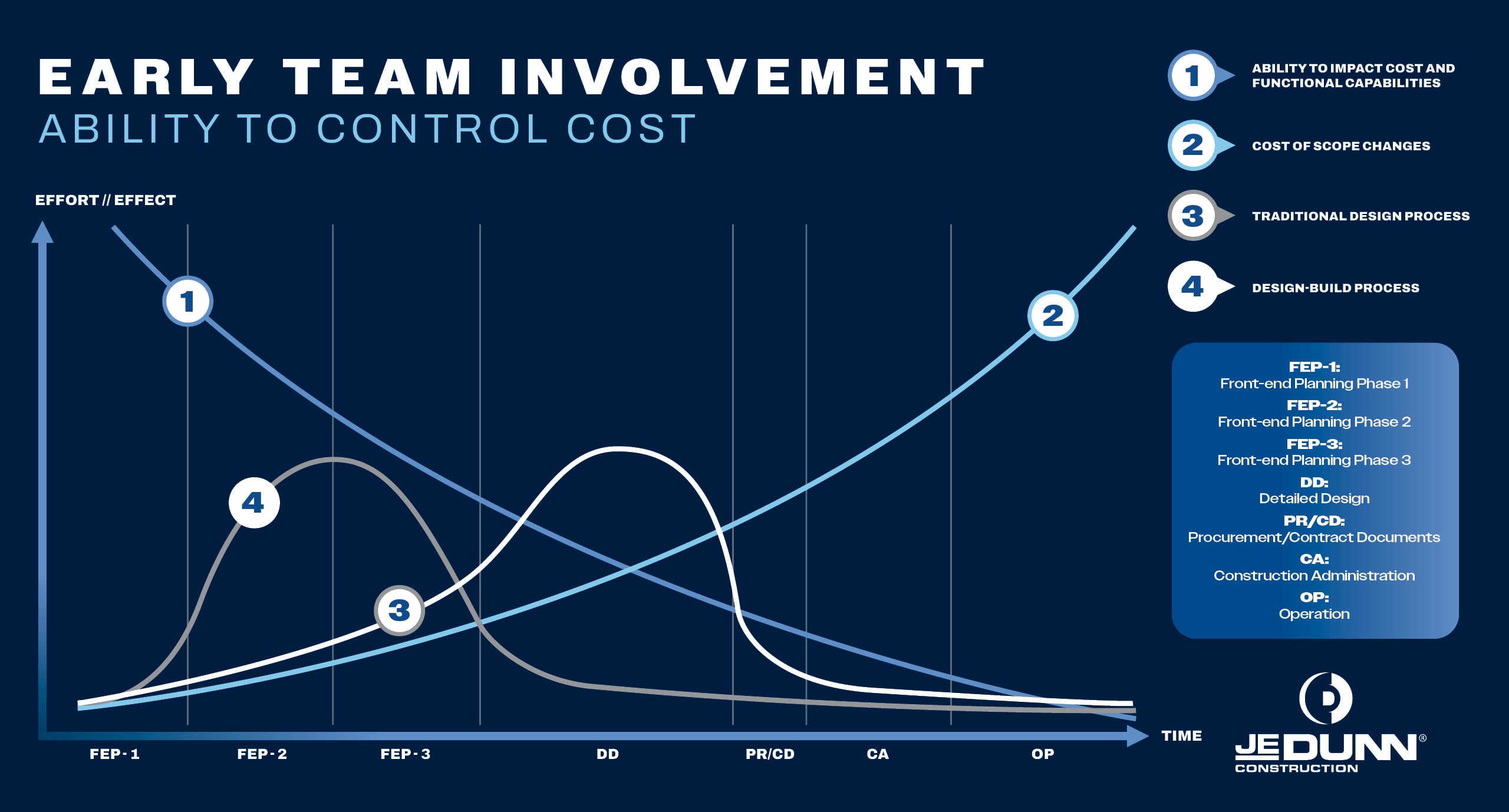
JE Dunn takes a proactive approach to design management by emphasizing early planning, aligning the team, and setting collaborative goals for budgeting and packaging to reduce rework. By framing it as design integration instead of design management, we develop a unified design and construction team, even in a CMAR contract arrangement, where no contractual obligation exists between design and construction.
To align early on project budget, one highly effective tool we use is a target value kickoff meeting. The purpose is to bring the design and preconstruction team together early to develop the initial conceptual project budget together. Typically, that initial project estimate is built in somewhat of a vacuum by an estimator using a preliminary design package or renderings. This requires a lot of assumptions to be made by the estimator, and often it is done with a target budgetary goal in mind. If a client has already established that they expect a specific total cost of construction, then the estimator will often build an estimate based on merging the preliminary design with that number.
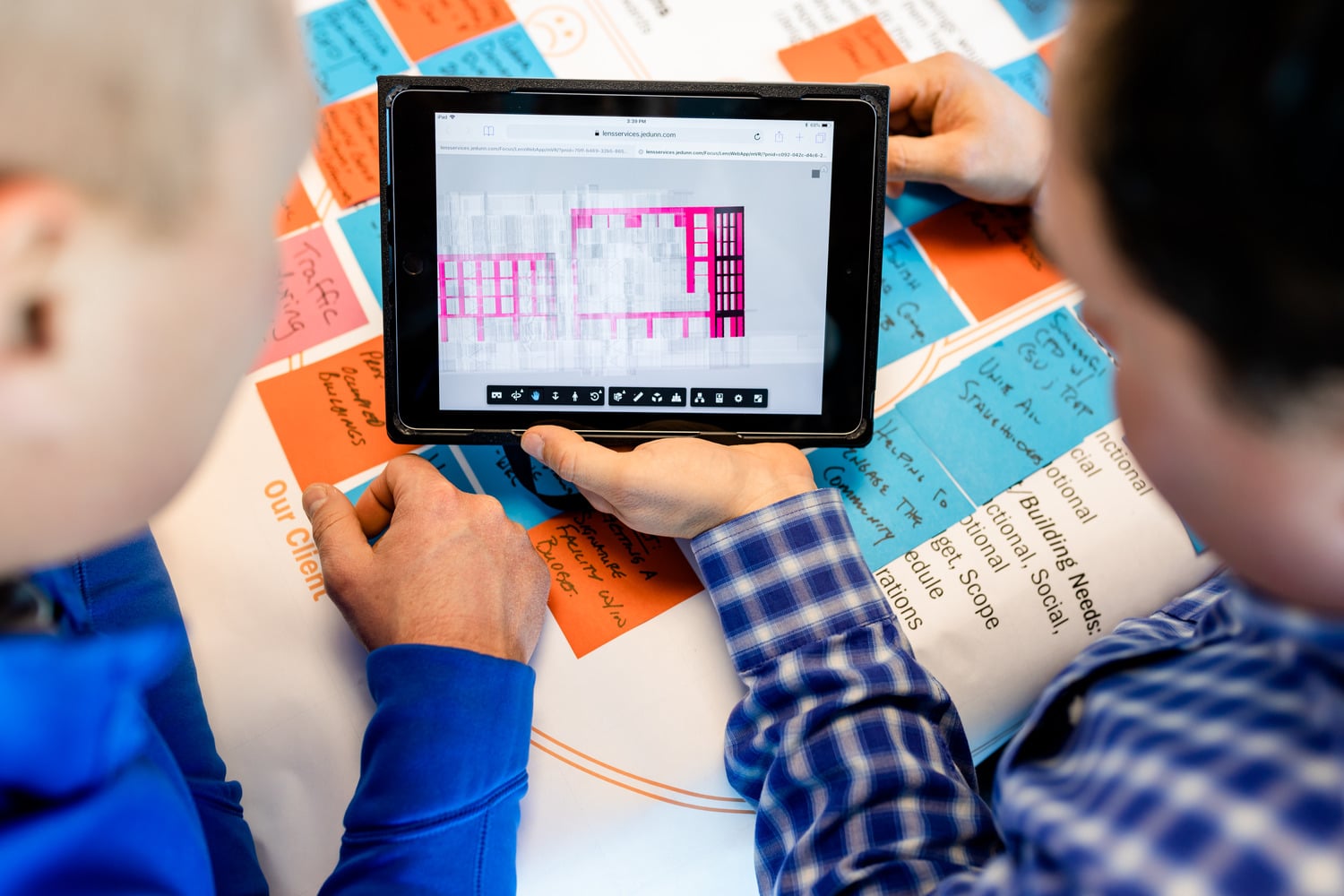
In a target value kickoff, however, that process is conducted in a group work session rather than by an individual. Ideally, each design discipline will be represented in this session, along with the construction and preconstruction team, as well as the client and any client stakeholders. Our design manager will then lead a process of working through our proprietary software, Lens Align, to build a detailed conceptual cost estimate in real time by asking questions from the team. During this process, multiple iterations can be evaluated with real-time feedback on the cost impact of each option. After each decision is made, the preconstruction manager will update the data accordingly, and the total project cost estimate is updated on the screen for everyone to see.
One of the biggest benefits of this approach is that a collaborative estimate ensures project budget dollars are prioritized to the areas that are most important to the client. The design manager will guide this process by asking the team to build the estimate in the order of design and client priority, which aligns the team to a common set of goals. Naturally, elements of lesser priority become targets of cost-saving measures as needed, and the entire team leaves the exercise with full alignment on path to budget, and definition of how design goals will be met. Future progress estimates can then be conducted to refine and validate the previous assumptions. In projects where our team has implemented a cost alignment program like this, we have found that value engineering redesign due to design and budget misalignment is eliminated from the process.
Model-based estimating is another cost management tool that leverages proactive design and construction integration. It can be applied when the construction team joins the project later to set target values or is used alongside target value as a benchmark to confirm adherence to the initial plan. In either case, the goal of model-based estimation is the development of a real-time data link between the BIM model and the cost estimating software.
A model-based estimate is unique in that it requires some initial setup linking BIM assemblies to the corresponding associated cost model components. However, once this is created, the future estimate updates become automated. As design progresses and quantities change, this information is translated into the estimate directly.
The net effect of this activity is that each time the model is updated and uploaded to a shared server, the design team can receive an automated and updated cost estimate back in real time without delay.
Early design packages have become a default way for the construction team to build quicker schedules to meet client needs. By starting construction sooner with an early package, such as underground civil utilities, the project team can begin building while later stages of design are still underway. But early packages always come with some risk. If an issue is discovered later in the design process that affects work already being put in place, design changes can become extremely costly.
This is an area where effective design management can greatly reduce the risk of rework. A good design manager should have extensive design and construction experience and be able lead the process of developing an early package and deliverables strategy that prioritizes the lowest risk to coordination with the most effective path to construction progress. Ideally, we want the design team to have the most time available to spend documenting and coordinating, and each package should arrive through permitting and client approval just in time for construction buyout, contract execution and performance. A design package deliverables matrix is a valuable tool for coordinating and documenting the project plan. Each early package is outlined with defined expectations, requirements for procurement and execution, and specific deadlines. Through the development of this detailed list, our team has observed that the actual needs for any drawing package often require fewer drawings than are typically produced by the design team. Such misalignment of expectations can unnecessarily increase demands on the design team and elevate the risk of later miscoordination, which may impede the achievement of construction schedule objectives.
These are just a few of the tools and processes that our team uses to ensure project alignment between design and construction. We believe that successful projects are built upon a more proactive integration between design and construction at all points in the process that leverage the knowledge and ability of all disciplines as one cohesive unit. Our clients and our industry are growing in adoption of collaborative project delivery models, and effective design management will be the differentiator in ensuring that excellence in design becomes excellence in construction. By proactively integrating design, we not only deliver predictable and high-quality outcomes, but also build lasting trust and long-term relationships with our clients.

