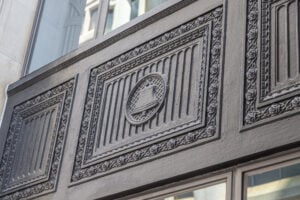

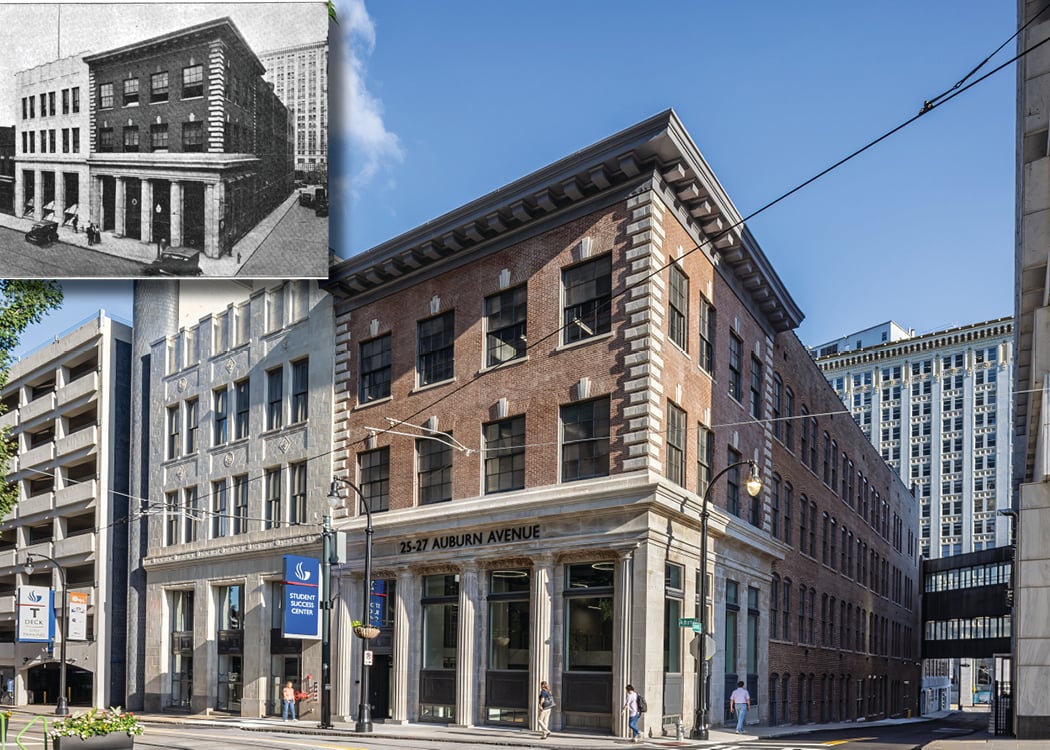


Georgia State University’s (GSU) Bell Building, a historic former Southern Bell telephone building dating back to the early 20th century, sat vacant for 30 years. Initially slated for demolition, GSU chose instead to renovate the landmark into a centralized hub for student support services after receiving significant philanthropic support. With consistent communication, thorough tech-informed planning, and a shared vision, design-build partners JE Dunn Construction and Lord Aeck Sargent worked to highlight the building’s architectural character while transforming it into a modern, engaging environment designed to improve graduation rates and student outcomes. After a complex abatement and restoration process, the newly transformed Georgia State’s Student Success Center and the National Institute for Student Success (NISS) stands ready to inspire students’ future success inside its historic walls.
The project’s scope was complex. JE Dunn’s team needed to preserve the architectural integrity of the historic landmark while adapting it for modern student success programs. This would require integrating advanced building systems while maintaining the century-old structure’s stability. These challenges were compounded by the need to install heavy modern HVAC and MEP systems in a building that posed engineering challenges. Teams also needed to complete their work with minimal disruption to the nearby MARTA light rail and the historic Sweet Auburn corridor while taking the narrow downtown Atlanta roads into account.
This project demonstrates what can be achieved when vision, teamwork and ingenuity come together. Faced with structural limitations, environmental hazards, and urban constraints, JE Dunn’s project team embraced creativity and technology to deliver a solution that both honors Atlanta’s history while also shaping its future. The team preserved a landmark while creating a blueprint for tackling complex challenges in historic, adaptive reuse projects.
Close collaboration between JE Dunn and design partner Lord Aeck Sargent was critical to coordinating and completing a safe, transformative renovation that addressed the historic building’s structural limitations, environmental hazards, and urban constraints. Together, the teams engaged in direct discussions and addressed challenges head-on to keep the project moving forward. At critical areas of the project, JE Dunn was able to look ahead and ensure updates, work, and decisions were made at the designated due dates to minimize impacts to the schedule. JE Dunn met with the design team, GSU, trade partners and local authorities on a regular basis to make sure all parties were being held accountable.
A regular meeting cadence encouraged feedback, strengthened coordination, and supported transparent decision-making to maintain momentum. With unmatched communication pathways set up from the start, construction and design teammates were able to deliver creative solutions to complex constraints, including an unconventional gas line condition. Limited space prevented placement of the gas meter on the building exterior or along the narrow street. Together, the teams designed a recessed exterior enclosure with a secure gate that met safety requirements while accommodating the site’s spatial limitations.
Technology played a key role in helping the project team balance preserving history with anticipating problems. JE Dunn leveraged laser scanning and VDC modeling capabilities to ensure the entire project team had access to a point-to-point laser scan of the entire building to assist in determining design plans and construction phasing. “It was tremendously helpful for all the wall layouts and existing conditions, because this building wasn’t created at perfect 90-degree angles like most new buildings are,” said JE Dunn Project Manager, Camilo Patino. These scans captured irregular angles and dimensions, which were critical for aligning new systems with the old structure.
With the right people and the right tools, Patino and other project team members overlaid construction drawings and actual ductwork and piping onto a model that included both the design team’s original model and the point-to-point laser scan. This allowed the team to see how the systems would fit in with real conditions. As a result, the team identified clearance conflicts early and adjusted the design before installation, avoiding costly rework.
JE Dunn showed the owner how discrepancies in the model would impact corridor widths and ceiling layouts before MEP systems were installed. This early visibility allowed the design team to evaluate the conflicts and develop revised solutions before construction progressed.
The basement housed most of the MEP equipment. The VDC team’s work allowed units to be laid out methodically, maximizing the limited space and maintaining required clearances. After the model was completed, JE Dunn invited the university and its maintenance team to review the future layout. Presenting a fully coordinated model with accurate clearances gave the client a clear understanding of how the space would function. Based on their operational experience, GSU staff provided feedback and adjusted equipment locations to better support long-term maintenance and access.
JE Dunn and the design team divided the project into two main phases. First, the project team worked extensively to make the building safe for further renovation. After sitting unused for three decades, vegetation had taken root in the roof and along the exterior walls and portions of the roof had collapsed. Long-term exposure to weather caused widespread damage. Bird droppings, animal infestations, and hazardous materials covered the interior. The team removed debris and remediated areas with lead paint and asbestos. A new temporary roof was installed to control the environment and alleviate deterioration while the design team worked through the design phases prior to construction. Crews also installed temporary lighting to improve site safety.
The second phase focused on preserving the building’s original charm and preparing it for modern usage. JE Dunn crews removed white lead-based paint on the exterior brick, windows, and terracotta facades. This process was extensive throughout and needed to be completed at the highest quality to bring the building skin back to its original look, especially since the exterior building would not be repainted. The lead abatement lasted several months. After the white paint was removed from the entire façade the original first-level windows that had been bricked over were exposed and completely replaced. Also, the original windows that were abated were then custom repaired in place to bring them back to as close to the original look as possible. All the windows could not be removed because the original frames were encased within the brick. Replacing all the windows would require removing most of the brick which would have impacted the intent of the façade restoration.
Phase two also addressed a water intrusion issue in the building’s basement. At times, there was between 12 inches and two feet worth of water below grade. The project team had to come up with an innovative, lasting solution to the problem.
JE Dunn worked along the design team to investigate the different locations where water could be coming in including City of Atlanta Watershed Department onsite meetings, Georgia Power underground vault investigation with Georgia Power, pH testing, water and piping tracking, underground camera reviews, and even investigating basement of surrounding building. After investigation, it was deemed that excavating underground could potentially impact the overall basement. The water management program they developed involved the following: