


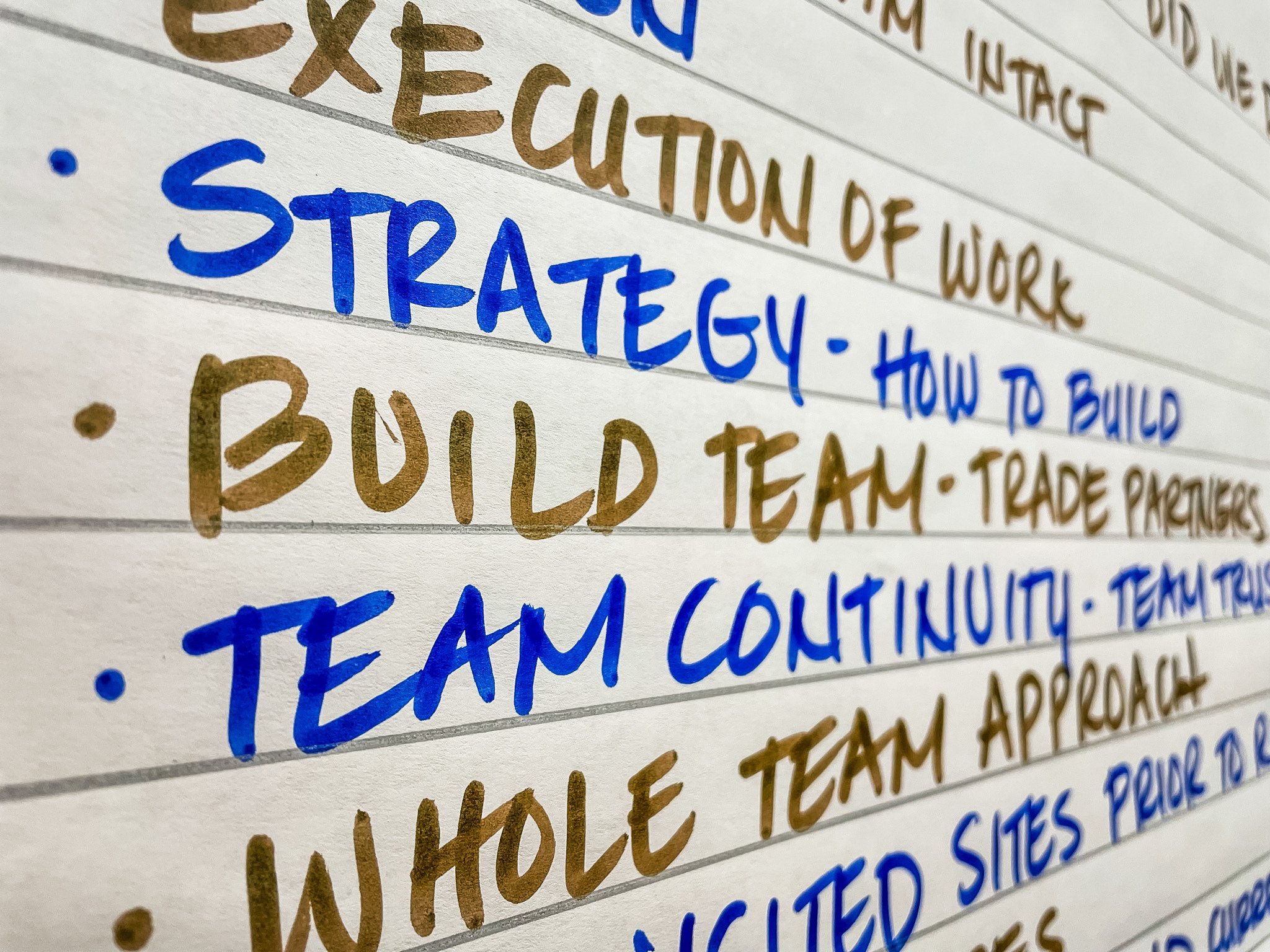


The four stages of team development are familiar: forming, storming, norming, and performing (Tucker’s stages of group development). In construction, we form new teams all the time.
Schedule and budget matter, but it’s the people who build buildings. Beyond the individual is the collective team that ultimately determines project experience. Each new project brings together a new team. Assumptions are often made that teams know how to work together from the jump, but even with some of the same clients or partners, each project and dynamic is unique.
There’s the sports saying, “Talent wins games, but teamwork wins championships.” Construction is the same. Skill will get the building built – great. But a high-performing team can also make the experience enjoyable for everyone involved. And that might be the greatest win of all.
Slowing teams down actually drives efficiency
Intentional slowing, of course. Think beyond construction for a second and consider your own life: how many of your best moments happened while you were in a rush? Probably none. For most of us, especially in construction, our default setting is “firefighting,” which seldom allows us the opportunity to get ahead.
Rushing typically causes more harm than good. In The Ruthless Elimination of Hurry, John Mark Comer says, “Hurry kills relationships. Love takes time; hurry doesn’t have it.” In an industry built on teams, strong relationships matter.
I’m not saying we have to love everyone we work with, but we should at least understand them. And that’s the intention behind high-performing teams. Investment in the time to truly get to know people fosters trust, the heart of any good team.
Instead of diving straight into conversations about the schedule and budget, taking the time upfront to clarify what success looks like to each team member and key stakeholder, establishing shared rules of engagement, and using self- and team-awareness assessments to improve communication makes a long-term impact.
The results may feel intangible at first, and especially foreign to a tangible, production-driven industry. But when inevitable conflict arises, teams that have taken the time to build trust are far better equipped to navigate difficult situations more efficiently and effectively. We take the assumptions out and have a plan for communication, just as we would for schedule and budget.
It’s often the small, deliberate pauses along the way that feel slow in the moment but ultimately moves us to the “performing” stage much faster.
“We began the OLCC project by getting to know each other, aligning on shared values and ‘rules of the road,’ and co-creating a team charter with the client and our design partner,” explained Project Executive, Stacey Flint. “That deliberate investment in trust, including clarity in how we operate, define success, and show up for one another, gives the team the strength to withstand inevitable challenges without losing connection or alignment. We remain cohesive and focused on the same goals. I strongly believe that when you build clarity and trust first, efficiency and resiliency follow.”
People leaders build genuine buy-in
Healthy hierarchy on a team provides structure, simplifies processes, and fuels the natural motivation people feel when they want to advance in their career. But like “firefighting,” stress rarely brings out our best. And while superintendents and project managers take a lot of pride in leading projects, the role carries a lot of weight. As stress grows, there’s a stark difference between managers only equipped to build and managers who know how to lead. High-performing teams help turn our managers into people leaders.
People leaders make strong decisions and have a clear vision, but maybe their most important strength is their ability to inspire others. That only happens through authenticity. Being willing to share how you like to communicate, what frustrates you, or how you like to be encouraged opens the door for others to be honest too. That kind of vulnerability builds trust.
We’re naturally motivated to work harder for the people and things we care about. In construction, crews often buy into the leader before they buy into the project. Even when a job is tough, people stay engaged when they feel respected, trust their leader, and know they’ll be supported.
But this style of leadership isn’t instinctive for everyone, and that’s okay. We can’t stop there though. Athletes don’t pick up a basketball and instantly become professionals; they train. Builders don’t grab a drill and automatically know how to build; they learn.
So why would we expect communication and leadership to be different?
It requires practice, repetition, and real effort. Because when difficult situations happen on the jobsite, that’s our game time, and preparation shows.
“I knew going into a large, important project that I had the capabilities to do well but was also aware that we would only be successful if we worked as a team. I couldn’t do it on my own, nor did I want to,” said Senior Project Manager, Caleb Jones. “I viewed our high-performing teams tools as an opportunity to develop not only the team but also myself. I genuinely want to be better and seeing feedback from your team forces you to face the issues head-on. It builds accountability that drives improvement. We’ve achieved the best results when we we’re vulnerable and honest with each other, and that starts with our people leaders demonstrating they value what their people are saying.”
Realizing even good things can get better
High-performing teams is foundationally one simple question: how can we improve? It’s a relational lens, yes, but the impact is on the entire project.
Slowing down to understand team needs is not a one-and-done solution, it’s an ongoing commitment. Teams grow throughout a project, adding new team members on a regular basis. And we’re people after all: our needs shift, our lives change, and our capacity ebbs and flows. Projects evolve too: owner’s needs shift, markets move, or external factors play a role. Complacency will kill teams. It’s naïve to pretend it won’t.
We’ve all heard the motto “1% better every day,” but the Flow Framework, which aims to optimize the entire delivery process, emphasizes 4%. It’s the idea that when you’re looking for continuous improvement, you should strive to see a 4% increase in productivity as the common benchmark. It’s all related; emphasizing the importance of tiny, consistent improvements.
Traditional “lessons learned” are useful for technical and constructability purposes, but because of this variability, they aren’t always as beneficial when we look at the relational side of work. That’s why we focus on real-time awareness through quarterly health assessments. This gives us a current picture of how we are maintaining a healthy team, based on what the team needs right now. When teams are healthy, their energy stays directed at work, not navigating dysfunction.
These assessments also highlight emerging gaps so team leaders can respond early. For example, if the
“I’ve seen firsthand that high performance starts with creating an environment where everyone feels valued and heard,” said JE Dunn Senior Project Manager, Dave Hanson. “Over the past 18 months, our project team at Arizona State University has completed several Team Health Assessments, and these ‘check-ups’ have given us real insight into morale, communication, trust, and alignment. We now make a deliberate effort to spend time together outside the job site, creating space to connect on a personal level, openly share challenges, and strengthen our relationships as we continue to grow together. When the team is healthy, the work improves, the experience improves, and we deliver results for our clients that none of us could achieve on our own.”
We have a real opportunity to influence the culture of our teams. Focus on incremental improvements, not monumental change. High-performing teams aren’t built overnight; they emerge from consistent habits, shared trust, and a willingness to learn together. By embracing these small steps, we build meaningful relationships that allow us to perform at a high level and transform the project experience.
Contributors: Stacey Flint, Dave Hanson, and Caleb Jones
Fill out the form to receive The Look Ahead, JE Dunn’s quarterly economic report.
Request company information or get connected with our experts for press releases, trade publications, and other news updates.
