


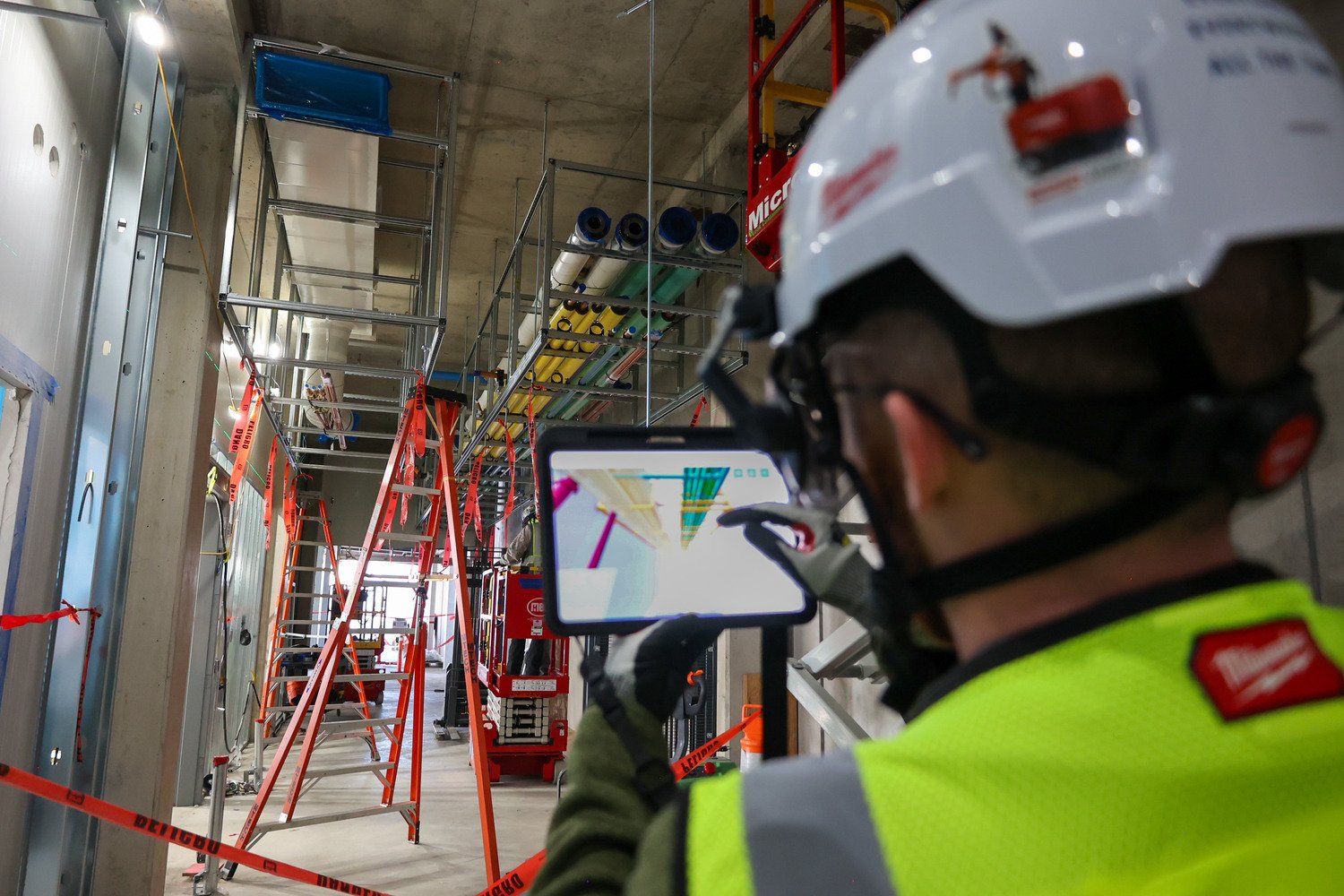


JE Dunn Construction is piloting the Department of Energy’s (DOE) first contract under the new Cooperative Construction Contracting Approach. To meet a compressed schedule and ensure top-quality outcomes, JE Dunn’s prefabrication team worked with trade partner MTech to construct and install 66 multi-trade racks to support advanced research operations in the new laboratory and provide flexibility for system expansion in the future — all with zero recordable safety incidents.
The National Laboratory of the Rockies (NLR) Energy Materials & Processing at Scale (EMAPS) facility is a 129,000-square-foot, three-story laboratory designed to support advanced research operations. Each floor includes a 250-foot-long utility corridor capable of supporting complex building systems. Although these corridors were not originally designed with multi-trade racks (MTRs) in mind, the project team identified prefabricated MTRs as a key strategy to deliver high-quality installations while maintaining schedule certainty on a highly complex project.
The final solution consisted of prefabricated rack modules approximately 20 feet in length. Two parallel runs of 11 racks were installed per floor, resulting in 22 racks per level and a total of 66 racks throughout the facility.
The prefabricated MTR strategy on the NLR EMAPS project delivered a higher level of quality by forcing early coordination and decision-making across all trades. Systems were designed, reviewed, and built in a controlled environment before reaching the jobsite, significantly reducing clashes, field modifications, and rework.
Completing racks off-site also created schedule certainty. With fully coordinated, tested, and protected racks staged and ready for installation, the team reduced exposure to unpredictable jobsite conditions such as congestion, access limitations, and trade interference. This allowed installation activities to be planned and executed with confidence, even within tight installation windows.
Safety was a measurable benefit of the approach. It has been estimated that 70% of the onsite hours associated with the MTRs were performed offsite. By shifting work away from congested field conditions and into a controlled fabrication environment, the team reduced material handling, overhead work, and trade stacking. As a result, the MTR scope was completed with zero recordable incidents, reinforcing prefabrication as a strategy that improves safety alongside quality and schedule performance.
The project schedule was highly compressed, with limited field installation windows and little tolerance for rework or delays. Traditional stick-built installation in the utility corridors would have required extended trade stacking and sequential work that the schedule could not support.
By using prefabricated MTRs, the team was able to fabricate and fully coordinate systems off-site while building construction continued in parallel. This approach removed a significant portion of work from the critical path and reduced schedule risk. The project team has stated that maintaining the overall project schedule would not have been possible without the MTR strategy.
MTech, the mechanical contractor, led the design and engineering of the MTR systems. The racks were constructed with future proofing in mind to maximize flexibility and allow for system expansion. To support long-term adaptability, the racks were intentionally overdesigned for weight capacity, ensuring they can accommodate future loads without modification.
Early and intentional coordination across trades was central to the success of the effort. Collaborative planning sessions utilizing Mural boards and pull planning techniques aligned design intent, fabrication sequencing, and installation planning. This upfront coordination resolved conflicts before fabrication began, significantly reducing the need for field adjustments.
Rack fabrication occurred at a dedicated off-site facility located approximately five miles from the project site. Each rack followed a defined six-day production cycle that included structural fabrication, system population, insulation, painting, and temporary protection. Multiple active build stations allowed the team to maintain a consistent and predictable production flow aligned with project milestones.
Trade responsibilities were clearly defined to support quality and efficiency:
This controlled, multi-trade fabrication environment enabled higher quality outcomes than would have been achievable through traditional field-built methods.
Each rack assembly underwent comprehensive quality assurance procedures prior to shipment. Mechanical systems were pressure-tested with full documentation to ensure compliance and traceability. Individual system connections were capped, and completed racks were fully shrink-wrapped (boat wrap) to protect against damage during transportation, storage, and handling.
To support off-site fabrication, the project team proactively collaborated with the Authority Having Jurisdiction (AHJ) to confirm inspection requirements and approval processes for prefabricated components. This early alignment ensured that systems fabricated off-site met all applicable codes and inspection standards, eliminated uncertainty during installation, and prevented delays or rework once racks were delivered to the jobsite.
MTech managed all transportation and logistics activities. Racks were delivered on 32-foot flatbed trucks using forklifts. Units were staged in an onsite laydown yard and moved into final position using forklifts or cranes as site conditions dictated.
Installation began with the pre-installation of anchors using a Hilti Jaibot, guided by coordinated model data and structural requirements. Once delivered to the appropriate floor, racks — equipped with heavy-duty casters — were maneuvered into position by small crews. Incremental lifting using electric forklifts allowed for precise placement, after which all-thread rods were aligned with preinstalled bracketry, cut to length, and secured per project specifications.
Fill out the form to receive The Look Ahead, JE Dunn’s quarterly economic report.
