


Many health systems today are grappling with strained facilities, aging infrastructure, tight capital environments, and increasing pressure to support growing patient volumes, all while keeping critical operations reliable. These converging forces make it essential to rethink central utility design with an eye toward long-term performance and adaptability.
In the last 15 years, JE Dunn has completed over 60 CUP/CEP projects across the country, including new, expansion and modernization projects. JE Dunn’s preconstruction team clarifies needs early, tests solutions against budget and schedule constraints, and leverages data-driven, experienced-based planning to deliver resilient, right-sized, and maintainable facilities, creating a smooth, transparent experience for our clients from day one.
As existing CUPs age, plant operators may face increasing pressure from equipment nearing end-of-life, reduced redundancy, and outdated infrastructure that could no longer keep pace with the clinical and operational demands of modern healthcare.
Piedmont Augusta’s CUP expansion and renovations project required early preconstruction and design phase services to evaluate aging infrastructure and plan upgrades that continuously support an acute care hospital and its multi-campus system. These early efforts identified risks, predicted downtime, and created a clear roadmap for a reliable, right sized central plant before construction ever began. For a system of this scale, reliable utilities are non-negotiable. A smooth CUP switchover is planned long before construction starts. During design, the design phase team maps every sequence, temporary utility, isolation point, and risk scenario so the new plant can be built while the existing one stays fully operational. This gives field teams a clear, coordinated plan that protects patients, staff, and critical systems when it’s time to transition.
Through early, disciplined scheduling and procurement along with the support of our in-house MEP services team, JE Dunn accelerated progress on Piedmont Healthcare Augusta’s CUP by securing critical equipment long before traditional timelines allow. At the time, critical components carried significant lead times:
Rather than waiting for fully developed construction documents or trade partner onboarding, our early procurement strategy intentionally starts the clock early allowing the design team time to finalize details while also providing greater budget confidence as major cost drivers are locked in upfront.
For Piedmont Augusta, we achieved cost certainty for roughly 15% of the work before construction documents were complete. This budget certainty is extremely beneficial, considering the volatility of major MEP equipment compared to more stable materials like concrete or masonry. This proactive approach reduced risk, stabilized pricing, and ensured the project stayed aligned with Piedmont Augusta’s operational budget and schedule priorities.
For Piedmont Augusta, the coordination of the old and new buildings started with a detailed review of existing infrastructure and every system the hospital depended on to stay operational. Our preconstruction team mapped out each tie-in, shutdown, and temporary configuration, aligning structural, MEP, and life-safety needs long before construction began. By resolving conflicts early and sequencing the work around real-time hospital operations, we ensured the new facility integrated seamlessly with the existing campus while keeping patient care uninterrupted.
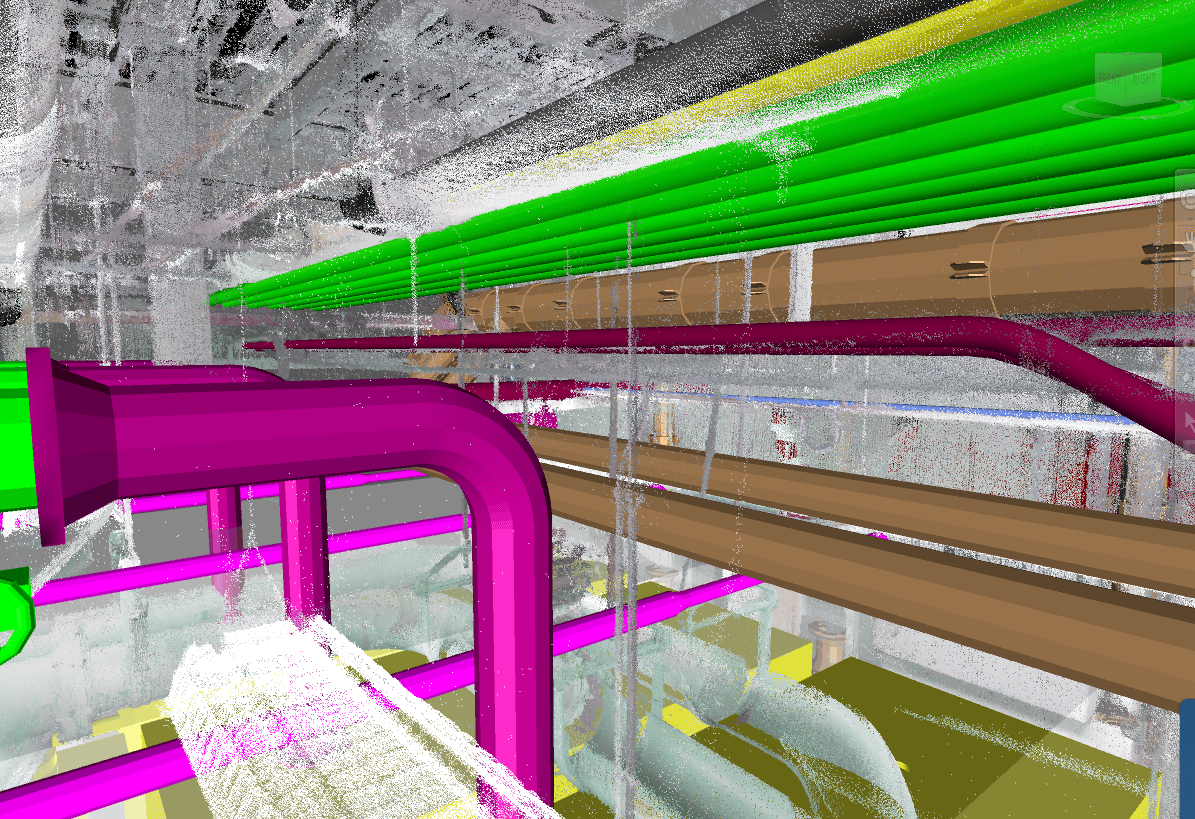
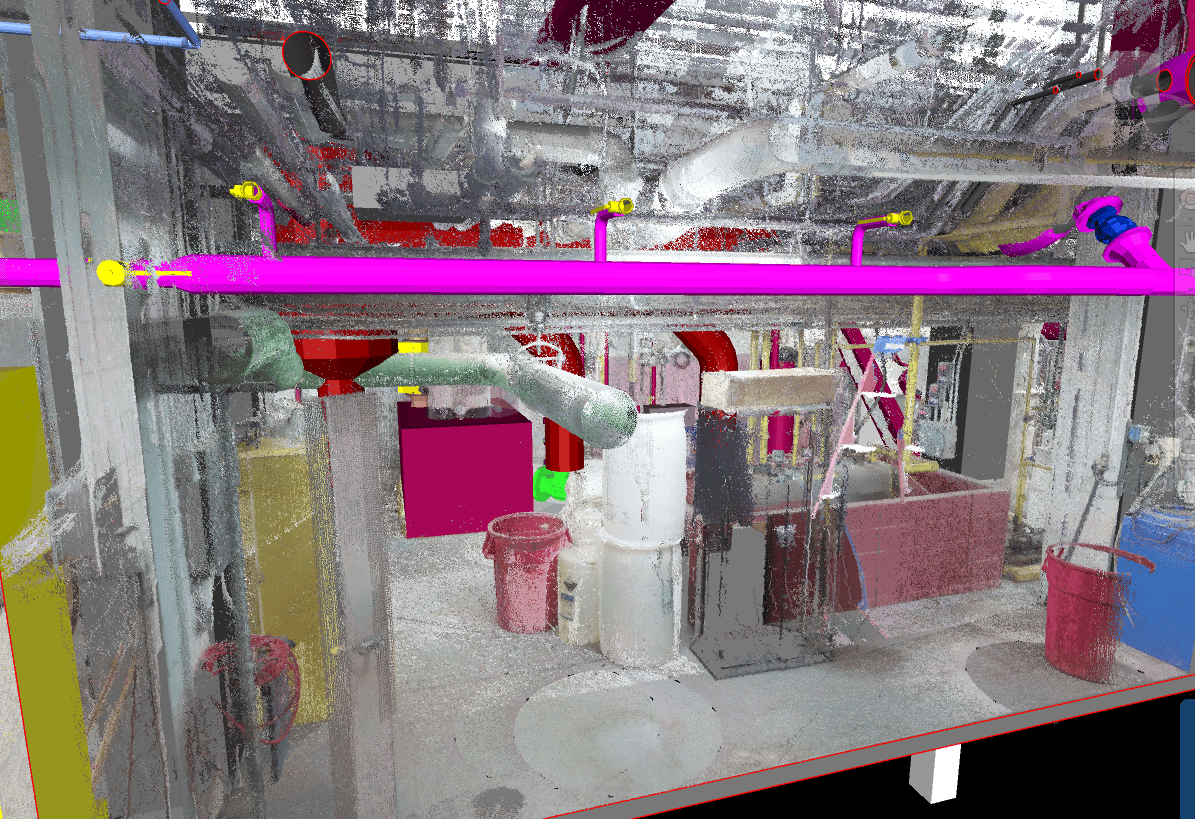
Image 1: This image shows gas connections for future phase 2 boilers that are overlayed on the existing condition of the laser scan.
Image 2: The conduit rack in green had to be coordinated to go between the mechanical pipe headers so the rack could be installed before the boilers are installed.
We worked with the design team and plant engineering to develop an enabling package, which included the testing and replacement of valves as required to rebuild redundancy into their chilled water and heating systems. The re-establishment of control within their systems allowed for the planning of equipment replacement and helped solidify a sequence to perform the work.
A three-dimensional scan of the existing plant was performed to help model what equipment and piping would be removed in each phase, and what space would be freed up for the new equipment and piping. To facilitate the connection of the new plant to the existing plant, underground investigative work was performed to find all utilities. These discovered utilities were also put into a three-dimensional model so the route for new piping that connected the two plants could be mapped out and any infrastructure modifications required could be planned.
Virtual Design and Construction (VDC) plays a critical role in risk reduction and sequencing CUP work far in advance. In CUPs, space is limited, equipment is massive, and shutdown windows are unforgiving. Our VDC group gives the team the clarity they need to make smart, safe decisions as early as possible. For Piedmont Augusta, our modeling efforts focused on elevating an already well-coordinated design. The design team had done an excellent job accounting for existing conditions, and the renovation work fell largely within one trade partner’s scope, which was responsible for nearly 90% of the mechanical room.
Our VDC team used the model to add construction-level detail, validate the approach, and highlight a few select areas where spatial relationships or sequencing were worth a closer look. This meant there were no major surprises or drawing discrepancies . Instead, the scans reinforced confidence that the design would fit as intended. Without the model and scans, even small discrepancies could have created field conflicts, rework, or shutdown delays. Instead, the team entered the construction phase with a clear digital roadmap— one that kept risk low and the path forward predictable.
Early planning kept patient care protected at every step. The team aligned scope, sequence, and procurement to stabilize cost and schedule, and digital coordination strengthened confidence in the design. The result is a central plant ready to support Piedmont Augusta for years to come.
Fill out the form to receive The Look Ahead, JE Dunn’s quarterly economic report.
