


Prefabrication, when planned early, can save time and money and help you achieve ambitious schedule goals. Prefabrication covers a wide range of work you see at a construction site, including the complex mechanical and electrical systems that power manufacturing plants. With nearly two decades of experience, JE Dunn’s prefabrication services provide clients with comprehensive options to achieve project goals such as greater cost and schedule certainty, ease labor constraints, and enable innovation that improves overall quality.
Prefabrication was once viewed as an option for projects, but today, it is considered essential. Industrial facilities can easily exceed 500,000 square feet, with some projects spanning hundreds of acres. The construction of these facilities requires considerable time, materials, and budget, making prefabrication an essential solution. To better understand the impact of prefabrication work on your project, consider these five key questions covering various aspects of building a new facility.
Meeting our clients’ aggressive speed-to-market goals is a top priority. With industrial facilities, the timeline of a project has accelerated in recent years and is even more magnified. Thankfully, speed is a key benefit of prefabrication work. As your construction team works on the core and shell of your project, prefabrication teams can simultaneously work on the interior components off-site. This parallel work accelerates the project because once the shell is complete, prefabrication teams can immediately begin to install components and allow successor scopes to start.
Outside of its impact on labor scheduling, prefabrication can also guarantee that the material needed is already procured. Material shortages continue to be a significant concern within the construction industry and can force delays on any project. At JE Dunn, we uphold project timelines by leveraging our extensive nationwide resources and strategically positioning them so that all our projects will be successful. We recently constructed an on-site prefabrication area to assemble 116,000 feet of piping, 95 pipe racks and other critical components on a battery materials project in northern Tennessee to resolve schedule constraints added to the project because of the time it took to transport materials and finished components. This strategic choice eliminated transportation time and accelerated our timeline exponentially, allowing us to shift workers and resources to other areas.
In addition to material constraints, the construction labor market is also feeling the strain, with the industrial and manufacturing segments being among the hardest hit. Large-scale construction projects require a larger workforce and are often built in remote areas for space concerns. These factors typically leave projects with limited labor options. JE Dunn has worked hard to develop and expand its prefabrication capabilities to mitigate these constraints and complete more work in-house.
Depending on a project’s needs, prefabrication also eases labor constraints through off-site flexibility. This is a major benefit when working with a small labor pool. JE Dunn’s off-site prefabrication teams can build complete modules that are dropped into place or deliver condensed kits of prefabricated materials to be installed on-site, allowing you to adapt to the skillset of your local labor pool. Taking work off-site also eliminates schedule stacking and enables you to use local labor resources more effectively. This helps keep sites organized and clean, positioning the entire project for success.
Involving your design and construction partners as early as possible, along with key trade partners, is vital. Bringing these teams in during the planning phases can maximize prefabrication use on your project. These partners can analyze what aspects of the project could benefit from prefabrication work by evaluating pain points related to cost, scheduling, labor and safety. For example, if you’re seeking creative ways to lower costs without modifying your timeline, material solutions through prefabrication can enhance cost certainty.
Another example that illustrates the impact of involving design and construction partners early is Georgia-Pacific’s new facility in Jackson, Tennessee. During the planning phases, JE Dunn’s team was able to tour another Georgia-Pacific facility to get a feel for what would be needed for the new build. This early evaluation led to the identification of several elements that could be prefabricated, including mechanical racks, pump skids, and piping systems. Each component was later built for modular assembly, ensuring easier installation at the job site. This approach shifted 42% of the required labor hours off-site and improved the project schedule.
Nothing is more important than the safety of workers. JE Dunn recognizes the mental and physical benefits of off-site work and its crucial role in enhancing working conditions and productivity.
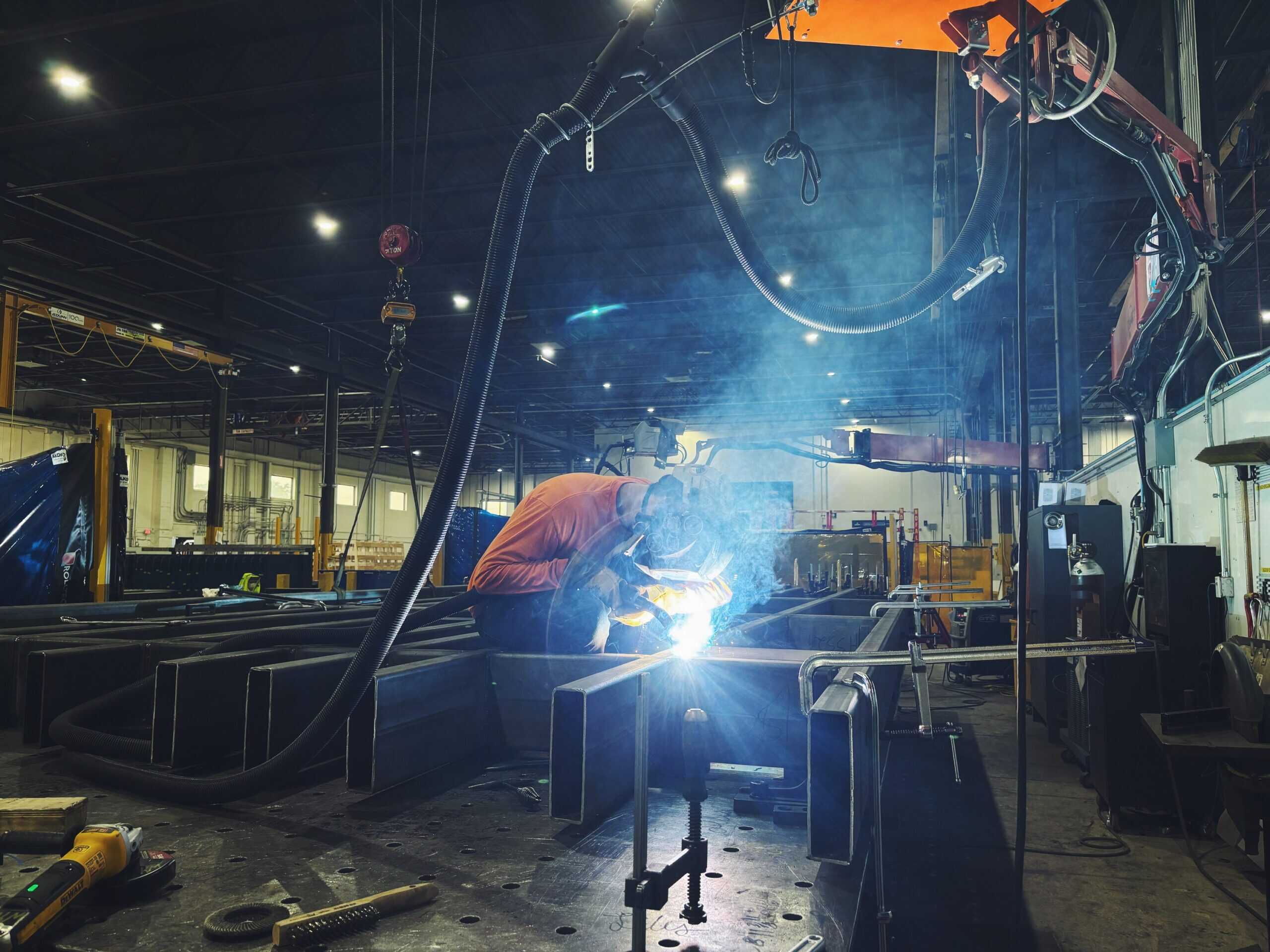
Off-site facilities are controlled environments that offer workers additional safety and resources. Key variables of projects that benefit from these conditions are weather and working at unsettling heights. Prefabrication facilities provide stable working environments and protection from rain and extreme temperatures. For projects with tight deadlines, having a controlled work environment is a game-changer that boosts overall productivity. When working at significant heights, prefabrication facilities provide enhanced safety by bringing tasks closer to the ground and utilizing specialized resources and equipment, minimizing risk and improving overall safety.
Maintaining quality through every project phase is essential when planning a new industrial facility. These projects require hundreds, sometimes thousands, of workers and numerous vendors, making consistent quality challenging to uphold. Assigning work to prefabrication teams helps mitigate this risk by ensuring consistency throughout the building process—a concept known as ‘scaling.’ This enables builders to produce larger quantities of components for diverse applications, maximizing quality. This work is also routinely reviewed and inspected, adding an extra layer of quality assurance.
As the construction industry adapts to different working norms, utilizing prefabrication on manufacturing projects has become a natural solution to ongoing and new challenges. Prefabrication services are no longer a luxury—they are essential to ensuring project success. Whether you’re looking to positively impact scheduling, labor, cost certainty, or quality and safety, prefabrication is the clear solution.
Fill out the form to receive The Look Ahead, JE Dunn’s quarterly economic report.
By submitting this information to JE Dunn Construction Company, you and your company represent and warrant that (i) the information you are submitting is true and accurate at the time of the submission; (ii) you are an authorized representative of your company who has the proper access and authority to provide this information, make these representations and bind your company.
JE Dunn Construction Company reserves the right to reject this information, reject your company as a potential bidder and terminate any contract or commitment without notice to you or your company if: (i) the information provided by you or another company agent is false, inaccurate, incomplete, unreliable, misleading or otherwise secretive; or (ii) you have failed to maintain, update and keep your company information true, current, complete, accurate and reliable.
In addition to any other rights, you acknowledge that any violation of the above representations will constitute an intentional or negligent misrepresentation. You also acknowledge that JE Dunn Construction Company will rely on the information provided by you to its detriment and that you and your company shall be responsible and liable for any damage or injury sustained by JE Dunn Construction Company in reliance upon such information.
Privacy and Confidentiality: JE Dunn Construction Company, its subsidiaries and related companies (“JE Dunn”) recognize and respect the privacy of the users of its Prequalification System (“System”). The information provided to the System will be considered confidential and used solely by JE Dunn Construction Company to evaluate the financial stability, resources, experience and other qualifications of your company to deliver high-quality goods and services at all times and/or according to the contractual requirements of a given project. Information provided in the Financial section of the System will be made available to only designated JE Dunn Construction Company Risk Management/Finance employees and will not be available to any other JE Dunn Construction Company employee.
JE Dunn Construction Company will store and restrict disclosure of your company information as allowed or required by applicable law, including disclosures that are necessary or advisable to (a) protect the rights, safety or property of JE Dunn Construction Company or others and (b) that conform to legal or regulatory requirements. Without your express approval, however, JE Dunn Construction Company will not knowingly disclose your company information to anyone outside of JE Dunn Construction Company.
